Beer Patent: Louis Pasteur Patents How to Brew Beer – January 28, 1873
Louis Pasteur, the renowned French chemist and microbiologist, revolutionized numerous industries with his scientific discoveries. Among his many contributions, his work on fermentation and pasteurization profoundly impacted the brewing industry. On January 28, 1873, Pasteur was granted U.S. Patent No. 135,245, titled “Improvement in Brewing Beer and Ale,” a landmark achievement that introduced a novel method to enhance the quality, quantity, and shelf life of beer. This article explores the context, details, and lasting impact of Pasteur’s beer brewing patent.
The Context: Pasteur’s Mission and the State of Brewing
In the 19th century, brewing was a significant industry, but it faced challenges related to spoilage and inconsistent quality. Beer often turned sour due to contamination by bacteria, wild yeast, or molds, limiting its shelf life and market reach. At the time, the brewing process involved boiling the wort (the liquid extracted from malted barley) and cooling it by exposing it to open air, which introduced airborne microorganisms that could spoil the beer. These issues were particularly pronounced in France, where the brewing industry lagged behind Germany’s thriving lager production, especially after France’s defeat in the Franco-Prussian War of 1870–1871.
Pasteur, motivated by both scientific curiosity and patriotism, sought to bolster French industry. His research on fermentation, begun in the 1850s, revealed that microorganisms, specifically yeast, were responsible for fermentation, debunking the prevailing theory of spontaneous generation. His studies on wine and beer spoilage further showed that unwanted bacteria caused souring. Inspired to improve French brewing and challenge German dominance, Pasteur turned his attention to developing a controlled brewing process, leading to his 1873 patent.
The Patent: A New Approach to Brewing
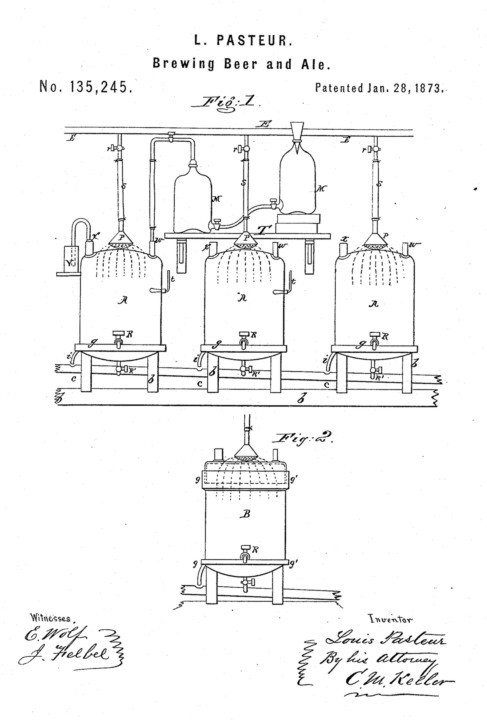
Pasteur’s U.S. Patent No. 135,245, filed based on a French patent from June 28, 1871, introduced a method to brew beer without exposing the wort to atmospheric air, thereby reducing contamination. The patent’s core innovation was to expel air from the boiled wort while it was confined in closed vessels and then cool it by applying water sprays to the exterior of those vessels. This process minimized contact with airborne microorganisms, resulting in a higher-quality beer that was less prone to spoilage.
Key Elements of the Patent
-
Air Expulsion in Closed Vessels: Traditionally, wort was cooled in open containers, allowing air to introduce bacteria and wild yeast. Pasteur’s method kept the wort in sealed vessels, expelling air to create a controlled environment that protected the liquid from contamination.
-
External Cooling with Water Sprays: Instead of exposing the wort to air for cooling, Pasteur’s process used sprays of water applied to the outside of the vessels. This maintained the wort’s sterility while lowering its temperature, preparing it for fermentation with selected yeast strains.
-
Improved Quality and Quantity: By preventing contamination, Pasteur’s method produced a greater yield of beer from the same amount of wort and ensured a more consistent flavor. The resulting beer also had a longer shelf life, making it suitable for transport and export.
The patent included a detailed description of an apparatus to implement this process, featuring domed vessels equipped with spray nozzles for cooling water, troughs to collect runoff, and faucets for transferring or dispensing the beer. This setup allowed brewers to maintain a sterile environment throughout the brewing process, a significant departure from traditional methods.
The Science Behind the Patent
Pasteur’s brewing patent was grounded in his broader research on fermentation and germ theory. In his 1876 book, Études sur la Bière (Studies on Beer), he detailed how yeast drives alcoholic fermentation and how bacteria, such as lactic acid bacteria, cause spoilage. He observed that heating beer to 55–60°C (131–149°F) could kill spoilage organisms without altering its flavor, a process later named pasteurization. While the 1873 patent focused on preventing contamination during brewing, it complemented his pasteurization techniques, which were applied post-fermentation to stabilize bottled beer.
Pasteur’s work also emphasized the importance of hygiene in brewing. He advocated for controlled environments and the use of microscopes to monitor yeast purity, practices that became standard in modern breweries. His insights into selecting specific yeast strains further allowed brewers to achieve predictable fermentation and consistent taste profiles.
Impact on the Brewing Industry
Pasteur’s patented brewing process had a transformative effect on the global brewing industry. By addressing spoilage, it enabled breweries to produce beer on a larger scale and ship it over long distances without quality degradation. This was particularly significant in the United States, where German immigrants like Pabst and Busch were establishing major breweries, and in Europe, where Carlsberg in Denmark adopted Pasteur’s methods to refine lager production.
The patent facilitated interstate and international commerce, as brewers could now export beer without fear of spoilage. In France, it bolstered the industry, with beers produced under Pasteur’s methods sometimes called bières de la revanche nationale (beers of national revenge), reflecting his patriotic intent to rival German brewers. Major breweries, including Whitbread in England, credited Pasteur’s influence for their adoption of scientific techniques, such as using microscopes to ensure yeast quality.
Pasteur’s work also paved the way for further innovations. For example, at Carlsberg, scientist Emil Hansen built on Pasteur’s research to isolate pure yeast strains, such as Saccharomyces carlsbergensis, revolutionizing lager brewing. These advancements marked the transition of brewing from an artisanal craft to a science-driven industry.
Legacy and Broader Influence
The 1873 brewing patent was one of two beer-related patents Pasteur filed that year. On April 4, 1873, he submitted U.S. Patent No. 141,072, “Improvement in the Manufacture of Beer and Yeast,” which covered a process for producing beer and yeast using microorganisms, marking the first patent for a microorganism. Together, these patents underscored Pasteur’s role in applying microbiology to industrial processes.
Beyond brewing, Pasteur’s research on fermentation and pasteurization had far-reaching implications. His discovery that microorganisms cause spoilage led to the germ theory of disease, which transformed medicine by linking microbes to infections. This insight inspired antiseptic techniques in surgery and the development of vaccines for diseases like anthrax and rabies. The pasteurization process, initially developed for wine and beer, became a standard for preserving milk and other perishable goods, improving public health worldwide.
Pasteur’s legacy in brewing is celebrated in institutions like the Pasteur Institute, founded in 1888, and in the continued use of his techniques in modern breweries. His work not only saved the French beer and wine industries but also laid the scientific foundation for modern microbiology and food safety.
Conclusion
Louis Pasteur’s U.S. Patent No. 135,245 for brewing beer and ale was a pivotal moment in the history of brewing. By introducing a method to brew beer in a controlled, contamination-free environment, Pasteur addressed longstanding challenges of spoilage and inconsistency. His innovation improved the quality, quantity, and longevity of beer, enabling the industry to expand globally. Rooted in his groundbreaking research on fermentation and germ theory, the patent reflects Pasteur’s ability to blend scientific rigor with practical solutions. Today, as craft and industrial breweries alike rely on controlled fermentation and pasteurization, Pasteur’s contributions remain a cornerstone of the beer we enjoy.
Sources
-
U.S. Patent No. 135,245, “Improvement in Brewing Beer and Ale,” January 28, 1873
-
Pasteur, Louis. Études sur la Bière. Paris: Gauthier-Villars, 1876
-
National Archives, Patent Case File No. 141,072, April 4, 1873
-
“Louis Pasteur and the Science of Beer Making,” National Archives, August 2, 2023
-
“Louis Pasteur: The Father of Fermentation,” Explore Yeast, May 13, 2022