Top 10 Belgian Witbiers brewed in America
This Top Ten Belgian Witbiers list is from the U.S. Open Beer Championship, Great American Beer Festival, World Beer Cup and Untappd reviews. The top 10 Belgian Witbiers / Belgian white ales are very pale in color and are brewed using unmalted wheat and malted barley and are spiced with coriander and orange peel. Coriander and light orange peel aroma should be perceived. Phenolic spiciness and yeast flavors may be evident at mild levels. These beers are traditionally bottle conditioned and served cloudy. An unfiltered nearly opaque haze should be part of the appearance. The style is further characterized by the use of noble-type hops to achieve a low hop bitterness and little to no apparent hop flavor. This beer has low to medium body, no diacetyl, and a low to medium fruity-ester level. ABV: 4.8-5.6%. IBU: 10-17
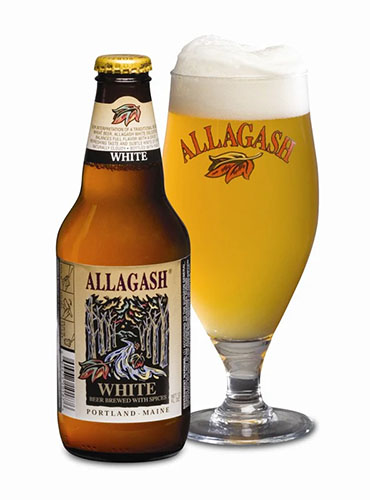 1) Allagash White – Allagash Brewing Co. (Portland, ME)
2026 World Beer Cup Gold + multiple past medals. Iconic hazy citrus-spice benchmark with exceptional balance.
Address: 50 Industrial Way, Portland, ME 04103
Website: https://www.allagash.com/
2) Suntrip – New Terrain Brewing Co. (Golden, CO)
2025 World Beer Cup Gold & GABF Bronze. Bright citrus-coriander wit with soft wheat texture.
Address: 16401 Table Mountain Parkway, Golden, CO 80403
Website: https://newterrainbrewing.com/
3) White Goblin – Mathews Brewing Co. (Lake Worth, FL)
2025 GABF Gold & U.S. Open Silver. Light, fruity, creamy classic with classic spices.
Address: 130 South H St, Lake Worth, FL 33460
Website: https://mathewsbrewingcompany.com/
4) Blue Heron Wit – Oregon City Brewing (Oregon City, OR)
2025 U.S. Open Gold. Traditional wheat-forward with orange peel and coriander.
Address: 1401 Washington Street, Oregon City, OR 97045
Website: https://www.ocbeerco.com/
5) Belgian Wheat – Devils Backbone Brewing Co. – Basecamp (Roseland, VA)
2025 GABF & World Beer Cup Silver. Reliable, yeast-driven wit with coriander and orange notes.
Address: 200 Crandall Run / 200 Mosbys Run, Roseland, VA 22967
Website: https://www.dbbrewingcompany.com/
6) Optimal Wit – Port City Brewing Co. (Alexandria, VA)
2024 World Beer Cup Gold + multiple GABF medals. Crisp, citrusy, well-balanced traditional wit.
Address: 3950 Wheeler Ave, Alexandria, VA 22304
Website: https://www.portcitybrewing.com/
7) Peppercorn Imperial Wit – Monkless Belgian Ales (Bend, OR)
GABF medalist from a Belgian-focused brewery. Bold yet light-bodied 8.2% variant with peppercorn, orange zest, and coriander spice.
Address: 803 SW Industrial Way, Bend, OR 97702
Website: https://www.monkless.com/
8) White Ale – Castle Island Brewing (Norwood, MA)
Strong 2025 U.S. Open/GABF performer. Bright, approachable American white with Valencia orange and coriander.
Address: 31 Astor Ave, Norwood, MA 02062
Website: https://www.castleislandbeer.com/
9) Breakside White – Breakside Brewery (Milwaukie, OR)
Past GABF Silver and consistent high placer. Quality, consistent U.S. wit with strong regional acclaim.
Address: 5821 SE International Way, Milwaukie, OR 97222
Website: https://breakside.com/
10) River North White – River North Brewery (Denver, CO)
Strong Untappd ratings and consistent performer from a Belgian/funky-focused brewery.
Address: 6021 Washington Street, Denver, CO 80216
Website: https://www.rivernorthbrewery.com/
History of Belgian Witbiers
Belgian Witbier, or “white beer,” traces its origins to the medieval brewing traditions of Belgium, particularly in the region of Brabant. Emerging around the 14th century, these beers were brewed with a significant portion of unmalted wheat, giving them a hazy, pale appearance and a light, refreshing character. Unlike the heavily hopped beers of the time, Witbiers were seasoned with a blend of spices and herbs, such as coriander and bitter orange peel, a practice known as gruit. Monastic breweries, like those in Hoegaarden, played a pivotal role in refining this style, with the village becoming synonymous with Witbier by the 19th century. However, the rise of industrial brewing and the popularity of lagers in the early 20th century led to a decline in traditional Witbier production, and by the 1950s, the style had nearly vanished, with the last traditional Witbier brewery in Hoegaarden closing in 1955.
The revival of Belgian Witbier began in the 1960s, largely due to the efforts of Pierre Celis, a milkman and former brewer from Hoegaarden. In 1966, Celis resurrected the style by founding Brouwerij Celis and reintroducing Hoegaarden Witbier, using traditional ingredients and methods, including wheat, oats, coriander, and Curaçao orange peel. His beer, with its cloudy appearance and spicy, citrusy profile, gained international acclaim, sparking a global resurgence of interest in Witbiers. By the 1980s, Celis’s success inspired other Belgian breweries and international craft brewers to produce their own versions, cementing Witbier’s place in modern craft beer culture. Today, Belgian Witbier remains a beloved style, celebrated for its light body, effervescence, and distinctive spiced flavor, with Hoegaarden still regarded as the benchmark.
Top 10 Beers in America – Ales Lagers Specialty Barrel Aged