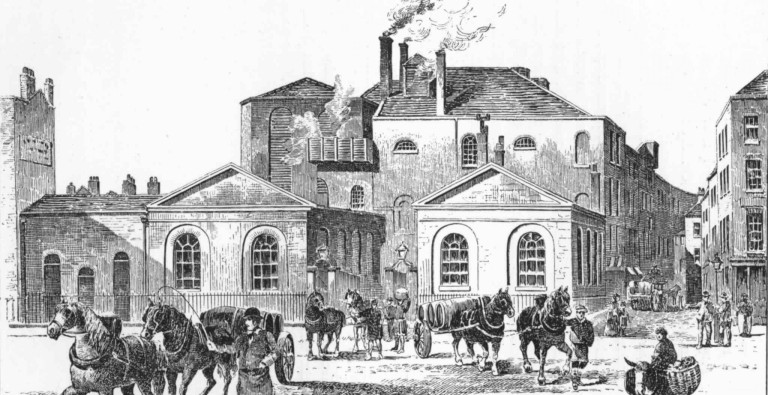
On October 17, 1814, a devastating incident known as the London Beer Flood struck the St. Giles district in central London, near Tottenham Court Road. This unusual disaster claimed at least eight lives when a massive wave of beer—reaching up to 15 feet high—burst from a brewery and flooded the surrounding slum area.
The Brewery and the Massive Vat
The Horse Shoe Brewery, operated by Meux and Company, stood at the intersection of Great Russell Street and Tottenham Court Road. In 1810, the facility added a gigantic wooden fermentation vat measuring 22 feet tall. Secured with large iron hoops, it could store more than 3,500 barrels of brown porter ale, a dark beer akin to today’s stout.
What Caused the Flood?
That fateful afternoon, one of the iron hoops on the vat snapped. About an hour later, the entire vessel ruptured with tremendous force. The explosion of hot, fermenting beer destroyed the brewery’s back wall and caused nearby vats to burst as well. In total, over 320,000 gallons of ale poured into the streets of St. Giles Rookery—a densely packed, impoverished neighborhood filled with tenements and residents facing hardship.
The Devastating Impact on the Neighborhood
The beer flood quickly overwhelmed George Street and New Street, creating a powerful 15-foot surge mixed with debris. It inundated the basements of two houses, leading to their collapse:
In one home, Mary Banfield and her young daughter Hannah were having tea when the wave hit, resulting in both deaths.
In another, four people attending a wake for a two-year-old child who had passed away the previous day were drowned.
The torrent also knocked down a wall at the Tavistock Arms pub, trapping 14-year-old barmaid Eleanor Cooper under rubble and causing her death.
Eight people lost their lives in all. Rescue efforts saved three brewery workers from waist-deep water and pulled one more from the wreckage.
Aftermath and Public Reaction
With beer flowing freely, locals rushed to collect it in buckets, pots, pans, and even hats. Some consumed it directly on the scene. Reports later emerged of a ninth death due to alcohol poisoning in the following days.
As The Times reported on October 19, 1814:
“The bursting of the brew-house walls, and the fall of heavy timber, materially contributed to aggravate the mischief, by forcing the roofs and walls of the adjoining houses.”
In a somber development, some families charged admission to view the victims’ bodies. During one such gathering, the floor gave way under the weight of visitors, plunging them into a beer-filled cellar.
The strong odor of beer persisted in the area for months.
Legal Outcome and Industry Changes
Meux and Company faced lawsuits, but a judicial inquiry classified the event as an “Act of God,” clearing the brewery of liability. The company incurred losses around £23,000 (equivalent to about £1.25 million today) but recovered excise taxes on the destroyed beer. They also received £7,250 (roughly £400,000 in modern terms) in compensation for the lost inventory, which helped prevent financial collapse.
The tragedy prompted significant reforms in brewing. Large wooden vats were gradually replaced with safer lined concrete versions across the industry.
Legacy of the Site
The Horse Shoe Brewery operated until its demolition in 1922. Today, the Dominion Theatre stands on part of the former location, a reminder of this extraordinary historical event.