In the late 1950’s, the beginning:
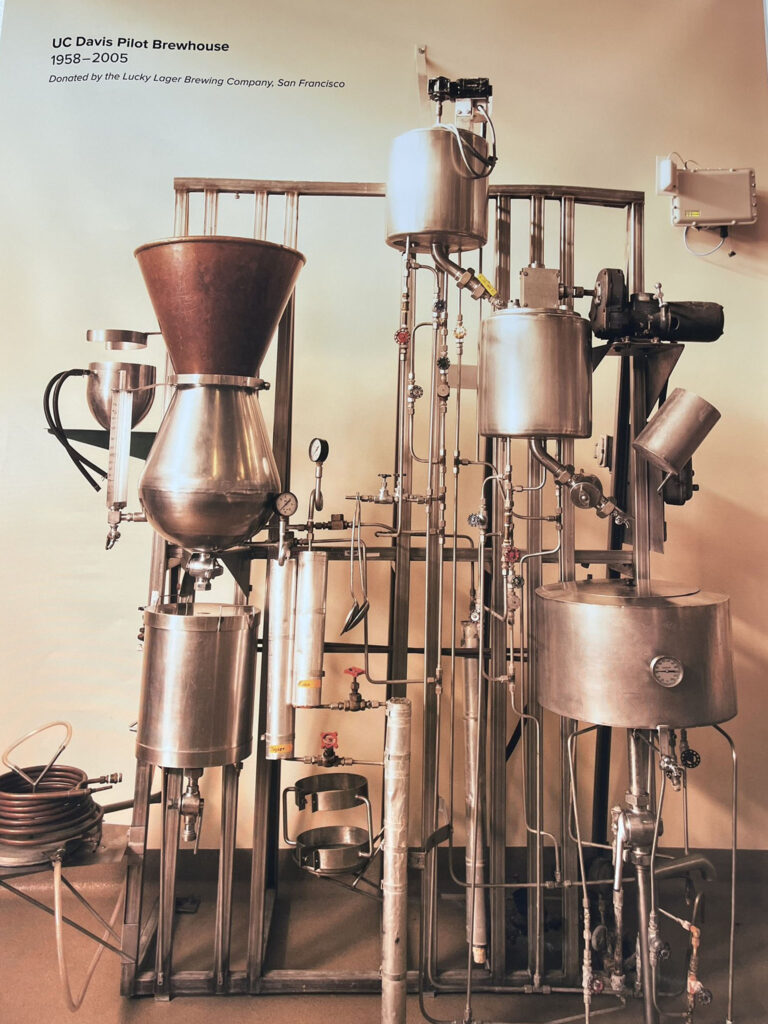
The UC Davis brewing program began in the late 1950s, driven by industry needs. In 1956, the Lucky Lager Brewing Company urged the university to train technical personnel, leading to equipment and funding donations from the company and the Master Brewers Association of the Americas. The first brewing technology courses in the U.S. started in 1958, taught initially by Dr. Herman Phaff (a yeast expert) and then Dr. Tommy Nakayama. These were held in Cruess Hall using a new pilot brewery dedicated on December 8, 1958. The focus was on complementing UC Davis’s strong wine fermentation program with scientific brewing education for industrial-scale production.
 1960s: Expansion Under Michael Lewis
The program grew significantly after Professor Michael J. Lewis, a biochemist specializing in yeast and fermentation, joined the Food Science and Technology faculty in 1962 (some sources note formal appointment in 1964). Lewis designed core courses like Malting and Brewing Science (lecture) and Practical Malting and Brewing (lab), emphasizing yeast physiology, biochemistry, cereal grains, enzymes, and beer flavor sensory analysis. These prepared students for roles at major breweries in an era of consolidated industrial lager production. In the late 1960s, Lewis collaborated with University Extension to offer professional short courses for industry professionals.
1970s: Milestones and Ties to Emerging Craft Brewing
Key developments included the introduction of the nation’s first four-year undergraduate degree in fermentation science with a brewing concentration for the 1971-1972 academic year. The program continued focusing on rigorous science for large-scale brewing, but it inadvertently influenced the craft beer movement. In the mid-1970s, classes included field trips to New Albion Brewing Co. (founded 1976 by Jack McAuliffe, the first U.S. microbrewery post-Prohibition). Homebrewing classes began in 1976, teaching sanitation, all-grain methods, and yeast selection amid rising amateur interest. Professional extension programs expanded.
Early 1980s: Continuation and Growing Influence
Under Lewis’s leadership (until his retirement in 1994-1995), the program maintained its emphasis on undergraduate and professional training in brewing science. The craft brewing scene began accelerating in the U.S. during this period, with UC Davis alumni and resources supporting early pioneers. Homebrewing and extension courses for amateurs and professionals continued, laying further groundwork for the craft revolution that boomed later in the decade and beyond. Graduates typically entered major breweries, but the scientific foundation influenced smaller operations.
Overall, from the 1950s to early 1980s, UC Davis transitioned from basic industry-supported courses to a comprehensive, science-driven program that trained brewers for industrial giants while unintentionally seeding the American craft beer renaissance through education, alumni, and connections to early microbreweries.
University of California, Davis
One Shields Avenue, Davis, CA 95616
Website: https://brewing.ucdavis.edu/