
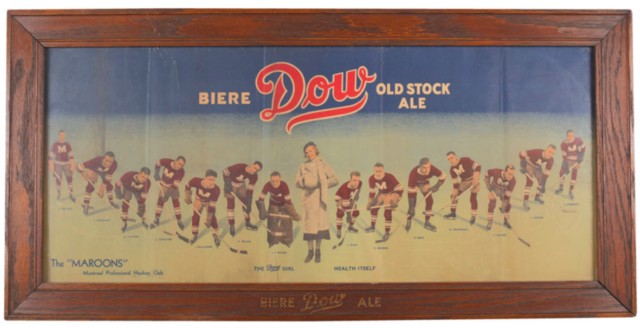
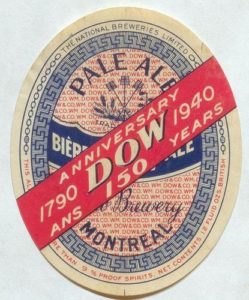
 In the rough-and-tumble world of Canadian beer, few brands ever achieved the mythic status of Dow Ale in Quebec. For generations, this rich, malty ale was a workingman’s staple, especially in the historic streets of Quebec City. Its story stretches back to the 19th century when William Dow, a Scottish immigrant, established his brewery in Montreal. By the early 20th century, through mergers and acquisitions, Dow had become part of National Breweries, one of Quebec’s brewing giants.
By the 1960s, the company’s flagship lineup included Dow Ale (the runaway bestseller), Kingsbeer lager, Champlain Porter, and Dow Porter. In Quebec City especially, Dow Ale wasn’t just beer — it was culture. Locals drank it by the dozen, and the brand enjoyed fierce loyalty.
 Then came the tragedy of 1966.
That year, hospitals in Quebec City began seeing a disturbing pattern: middle-aged men, most of them heavy daily beer drinkers, arriving with severe heart problems — specifically, a type of cardiomyopathy marked by irregular heart rhythms and, in many cases, fatal outcomes. Roughly 20 to 25 men died. While not every victim drank Dow, the majority did. The brand’s strong presence in the provincial capital made the connection impossible to ignore.
In an attempt to show good faith and calm public fears, Dow made a fateful decision: it ordered the destruction of its entire remaining inventory of Dow Ale at the Quebec City brewery. What was meant as reassurance backfired spectacularly. To the public, dumping the beer looked like an admission of guilt. Overnight, Dow Ale earned the grim nickname “la bière qui tue” — the beer that kills. The phrase still echoes in Canadian brewing lore today.
The Cobalt Mystery
Medical investigators never found conclusive proof that Dow Ale directly caused the deaths. However, many experts pointed to cobalt sulphate, a compound some brewers added in tiny amounts during the 1960s to improve foam stability and create that perfect, lasting head. Heavy drinkers in Quebec City were consuming enormous quantities of beer — often a dozen or more pints daily. Dow, it later emerged, appeared to have used significantly higher levels of cobalt than other breweries (some accounts suggest up to ten times the typical amount).
The condition became known in medical circles as “Quebec beer-drinkers’ cardiomyopathy.” Once Dow and other brewers stopped using cobalt, the cluster of cases vanished. The incident remains one of the most unusual and tragic episodes in North American brewing history.
The Long Decline
Sales of Dow Ale collapsed after the scandal. In 1972, the brand was sold to Molson Breweries in Montreal. Molson kept brewing it for another two decades until the early 1990s, but it never regained its former glory. The 1987 merger of Molson with Carling O’Keefe (the final evolution of the old National Breweries empire) effectively marked the end of Dow as an independent force.
A Surprising Culinary Legacy
Even in its darker chapters, Dow left behind an unexpected bright spot in Quebec’s food culture.
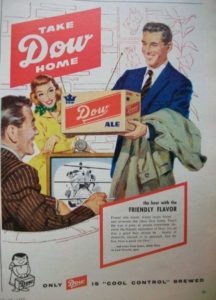
In the 1950s, long before the current wave of beer-and-food books, the legendary Quebec culinary authority Jehane Benoit worked with Dow Brewery. Benoit, who had trained in Paris under the famed gastronome Édouard de Pomiane, created promotional recipes and authored a cookbook titled Cooking With Dow. Though some recipes were her own inventions, the book stands as an early champion of beer in Quebec cuisine — proving that the idea of beer-based gastronomy in la belle province didn’t start in the 21st century. It was already happening in the kitchens of the 1950s, thanks to one of Canada’s greatest food writers and a now-infamous ale.
Today, Dow Ale is remembered as both a beloved classic and a cautionary tale. Its story is still discussed by beer historians, homebrewers, and anyone fascinated by how one chemical, one marketing decision, and one tragic coincidence can forever change a brand’s destiny.
The ghost of “la bière qui tue” still lingers in Quebec’s rich brewing heritage — a reminder that even the most legendary beers can have a dark side.
For Brewing fun fact, trivia, movies and more, Click Here.