• Skip to secondary menu
  • Skip to main content
  • Skip to primary sidebar

Beer Info

Beer News, Beer Releases and New Breweries

  • Home
  • Top 10 Beers
    • Ales
    • Lagers
    • Barrel Aged
    • Hybrid
    • Specialty
  • GABF
    • 2024 GABF
    • 2023 GABF
    • 2021 GABF
    • 2022 GABF
    • 2020 GABF
    • 2019 GABF
    • 2018 GABF
    • 2017 GABF
    • 2015 GABF
    • 2014 GABF
    • 2013 GABF
    • 2012 GABF
    • 2011 GABF
    • 2010 GABF
    • 1987 GABF
  • World Beer Cup
    • 2022 World Beer Cup
    • 2018 World Beer Cup
    • 2016 World Beer Cup
    • 2014 World Beer Cup
    • 2012 World Beer Cup
    • 2010 World Beer Cup
    • 2008 World Beer Cup
    • 2006 World Beer Cup
    • 2004 World Beer Cup
    • 2002 World Beer Cup
    • 2000 World Beer Cup
    • 1998 World Beer Cup
    • 1996 World Beer cup
  • U.S. Open
    • 2022 U.S. Open
    • 2021 U.S. Open
    • 2020 U.S. Open
    • 2019 U.S. Open
    • 2018 U.S. Open
    • 2017 U.S. Open
    • 2016 U.S. Open
    • 2015 U.S. Open
    • 2014 U.S. Open
    • 2013 U.S. Open
    • 2012 U.S. Open
    • 2011 U.S. Open
    • 2010 U.S. Open
    • 2009 U.S. Open
  • U.S. Open Cider
    • 2021 U.S. Open Cider
    • 2020 U.S. Open Cider
    • 2019 U.S. Open Cider
    • 2018 U.S. Open Cider
    • 2017 U.S. Open Cider
    • 2016 U.S. Open Cider
    • 2015 U.S. Open Cider
  • U.S. Open College
    • 2021 U.S. Open College
    • 2019 U.S. Open College
    • 2018 U.S. Open College
    • 2017 U.S. Open College
    • 2016 U.S. Open College
  • More
    • Schools
      • United States
      • Canada
      • Europe
    • Writers
      • Edwin Arnaudin
        • Zebulon Artisan Ales
        • Highland Brewing
      • Morgan Forsyth
      • Paul Leone
      • Austin Foster
      • Anne-Fitten Glenn
    • Books
      • Starting a Brewery
      • Homebrew
      • History
      • Fun & Games
    • Fun Facts

Andrew Innes

Louis Pasteur Patents How to Brew Beer – January 28, 1873

September 16, 2025 by Andrew Innes

Louis Pasteur Patents How to Brew Beer – January 28, 1873

Louis Pasteur Patents How to Brew Beer – January 28, 1873
Beer was first made by the Sumerians, and the technology was absorbed into the Babylonian and ancient Egyptian cultures. The practice of the Sumarians was to bake grains into bread, and the bread was moistened to begin the process of making beer. The baked bread was a way to preserve the grain for later use in the beer making process. A Sumerian beer was recreated recently by the folks at Anchor Steam Beer, as an experiment.

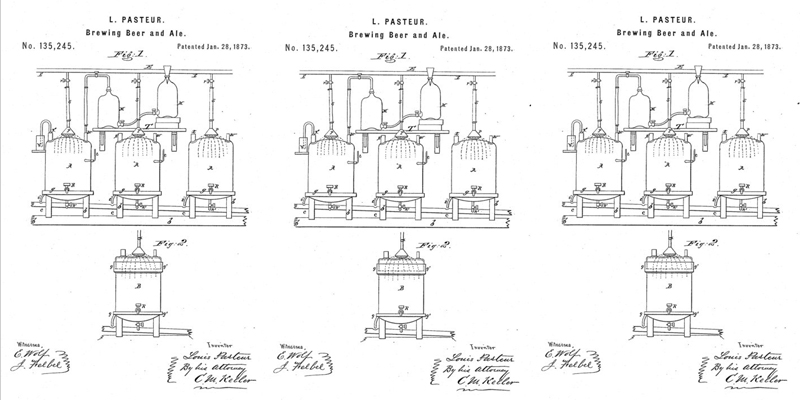
In more recent times, Louis Pasteur studied beer and wine making and patented a process for making beer which resulted in a better beer. Previously the wort was boiled and exposed to the air for cooling. In Pasteur’s process, the wort is kept in closed vessels and cooled by spraying the outside of the vessel with water. A special yeast was introduced into the mash after it cooled, thus preventing contamination of the wort with stray wild yeasts floating through the air.

More about Louis Pasteur
Louis Pasteur, the renowned French microbiologist and chemist, revolutionized the brewing industry with his pioneering research on fermentation and beer spoilage in the 19th century. Through meticulous studies, Pasteur proved that alcoholic fermentation is caused by living yeast cells converting sugar into alcohol and carbon dioxide, debunking the outdated theory of spontaneous generation. His groundbreaking 1876 book, Études sur la Bière, detailed the “diseases” of beer caused by contaminating bacteria and wild yeasts, providing brewers with scientific insights to produce cleaner, more consistent beers.

Pasteur’s discoveries led to the development of pasteurization—a gentle heating process that kills harmful microorganisms without altering flavor—first applied to beer to extend shelf life and prevent souring. This innovation not only elevated French brewing to compete globally but also laid the foundation for modern hygiene practices in the craft beer world, ensuring safer and higher-quality brews enjoyed by enthusiasts today. Pasteur’s enduring contributions continue to inspire brewers committed to excellence in fermentation science and product stability.

For Fun Beer Facts, Trivia and more: Click Here
Filed Under: Beer, breweries

1897 Patent application for a sheet metal beer keg and the history of the Beer Keg

June 18, 2025 by Andrew Innes

1897 Patent application for a beer keg or barrel submitted by Joseph C. Roth

Patent application for a beer keg or barrel submitted by Joseph C. Roth in 1897.

To all whom t may concern.-

Be it known that I, JOSEPH C. ROTH, a citizen of the United States, residing at Buffalo, in the county of Erie and State of New York, have invented certain new and useful Improvements in Kegs or Barrels, of which the following is a specification.

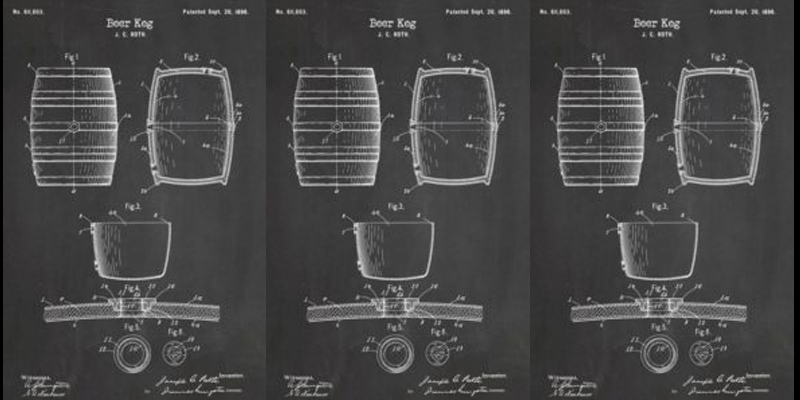
My invention relates to sheet-metal kegs or barrels, more particularly that class of barrels employed for beer, wines, or other liquors, and it will be fully and clearly hereinafter described and claimed, reference being had to the accompanying drawings, in which- Figure 1 represents a side elevation of a beer-keg made in accordance with my invention. Fig. 2 is a vertical section on or about line a  Fig. 1. Fig. 3 represents a vertical central section through one section of the in-V ner case of the keg or barrel. Fig. 4 represents an enlarged sectional elevation through a portion of a side of a keg, the section passing centrally through the bung-hole and showing the construction thereof. Fig. 5 represents a detached top view of one of the outwardly-screw-threaded inner rings. Fig. 6 represents a top face View of the improved bung.

Referring to the drawings in detail, 1 and 1 represent, respectively, the two outer sections, Which are preferably stamped from sheet steel of suitable size and thickness, one section being provided with an enlarged rim 2, which overlaps the edge 2n of the other section when tied together. The outer sections are also provided with strengthening enlarged portions or’peripheral rings 3, which are designed to represent the hoops of an ordinary barrel. The interior sections 4 and 4% are also preferably stamped from sheet-steel, the edge 5 of one section also being enlarged to overlap the edge 5 of the other. (See Fig. 2.) A filling of asbestos 6 is interposed between the outer and inner sections. material may be used, but asbestos is preferred on account of its Well-known fireproof qualities. y

Informing the bung-holes (see Fig. 4) a circular opening 7 is formed in the inner section, having an outwardly-extending rim S, and an opening 9 of the larger circumference and adapted to register with the opening 7 in the inner Other section when the sections are all properly fitted together is formed in the outer section.

A circular ring 10, having an interior circular opening of substantially the same diameter as the opening 7 and an outer peripheral screwthread 11 terminating in a lower circular enlargement or flange 12, is seated upon and rigidly secured to the rim 8 by brazing or other well-known means. A circular portion 13, provided with an interior screw-thread 14, adapted to fit the screwthread 11, and inwardly and outwardly projecting top flanges 15 and 16, is screwed upon the ring 10 until the flange 15 comes in contact with and is firmly seated upon the top of the ring 10 and the outer flange 16 comes in contact with and is firmly seated upon the edge portion of the outer section surrounding the opening 9. The outer flange 16 is provided with the usual peripheral hexagonal portion 17 to receive the operating wrench or tool.

It will be noticed by referring to the drawings, particularly Fig. 2, that one of these bung-holes is placed at the juncture-point of the sections, another below the same, and one in the top end; but they may be differently arranged and more or less used if desired. The overlapping edges of the sections are rigidly fastened to each other by brazing or other well-known means.

The bung I intend to use with my improved keg consists of an outer ring of wood 18, which is driven tightly into the bung-hole, and an interior core of cork 19. (See Fig. 6.)

The ends of the kegs are also provided with circular projecting rims 20, which are adapted to be grasped by the ringers when handling the kegs.

My improved keg can be manufactured to conform exactly to the United States standard measure. It cannot shrink or leak, is absolutely water and airtight, and also fireproof. It keeps the beer or other liquid cooler in summer and warmer in winter, and the head cannot be knocked out and the keg used for any purpose other than as a receptacle for liquids.

The kegs are preferably covered with an interior and exterior coating of pitch, varnish, or enamel to prevent rusting the metal. I claim as my invention IOO A keg consisting of an outer metallic shell and an inner metallic shell each shell being formed in two sections with the edge of one section overlapping the other, a filling of asbestos or similar material interposed between the two shells, the inner shell having a series of circular openings provided with raised rings, supplementary annular ring portions each provided with a peripheral screw-thread terminating at its lower end in a peripheral enlargement or flange and brazed or otherwise rigidly secured to the top of one of the raised rings and the outer shell having a corresponding series of openings of the larger circumference and adapted to register with the corresponding openings in the inner shell and annular portions each provided with au interior screw-thread and a top flange and adapted to be inserted in one of the openings in the outer shell and screwed Upon the adjacent supplementary ring portion of the inner shell, as set forth.

Brief History of the Beer Keg
The beer keg has evolved over millennia from simple storage vessels to sophisticated pressurized containers essential for modern brewing and distribution.

Ancient Origins (c. 350 BC onward): Northern European Celtic tribes developed early prototypes of wooden barrels, improving on fragile clay pots for storing and transporting fermented beverages, including beer. The Romans adopted and refined these watertight oak barrels, enabling long-distance trade.

Medieval to 19th Century: Wooden barrels, crafted by skilled coopers, became the standard for beer storage, fermentation, and transport in Europe. They allowed natural carbonation and flavor development during aging, and were crucial for trade networks like the Hanseatic League.

Industrial Era Transition (Late 19th–Early 20th Century): The Industrial Revolution and pasteurization spurred the shift to metal kegs. First commercial metal (often steel or aluminum) pressurized kegs appeared by the late 1800s/early 1900s, offering durability, hygiene, and better carbonation control for mass distribution.

Modern Era (Mid-20th Century Onward): Stainless steel kegs with single-valve systems (e.g., Sankey couplers introduced in the 1960s) became dominant, allowing efficient cleaning, pressurization with CO₂, and widespread draft beer service. Today, standardized sizes (e.g., 15.5-gallon U.S. half-barrel) support global brewing.

This evolution has enabled beer to remain fresh over longer periods and distances, transforming it from a local product to a global commodity.

For Fun Beer Facts, Trivia and more: Click Here
Filed Under: Beer, breweries

The History of the August Schell Brewing Company

May 3, 2025 by Andrew Innes

The History of the August Schell Brewing

Nestled along the Cottonwood River in New Ulm, Minnesota, the August Schell Brewing Company stands as a testament to family tradition, German heritage, and unwavering resilience. Founded in 1860 by German immigrant August Schell, it is the second-oldest family-owned brewery in the United States, surpassed only by D.G. Yuengling & Son. As one of the few pre-Prohibition breweries still operating under family control, Schell’s has weathered wars, economic turmoil, and the 13-year ordeal of Prohibition, emerging as a cornerstone of American brewing history. This article delves into the brewery’s origins, its survival through Prohibition, and its enduring legacy as a craft beer pioneer.

The History of August Schell Brewing Company
August Schell was born on February 15, 1828, in Durbach, in the Grand Duchy of Baden, Germany. At age 20, he immigrated to the United States in 1848, seeking opportunity amid the political unrest following the failed revolutions in Europe. After working as a machinist in Cincinnati, Ohio, Schell joined a group of German immigrants from the Turner Society, a cultural and gymnastic organization, to co-found the town of New Ulm, Minnesota, in 1857. Recognizing the growing German population’s thirst for traditional beer, Schell partnered with Jacob Bernhardt, a former brewmaster, to establish a small brewery in 1860. They chose a scenic site two miles from New Ulm’s center, where spring water and ice from the Cottonwood River provided ideal brewing conditions.

The brewery began modestly, producing about 200 barrels annually. In 1866, Schell bought out Bernhardt, assuming sole ownership and initiating an unbroken chain of family stewardship. Despite challenges like the Dakota War of 1862, which damaged much of New Ulm but spared the brewery, Schell’s operation grew steadily. By the 1880s, the family built a grand mansion, gardens, and a deer park on the brewery grounds, now listed on the National Register of Historic Sites. August invested in advanced equipment, including a $25,000 copper brew kettle, optimizing production for the acidic wort and beer. When August died in 1891, his wife, Theresa, inherited the brewery, with their son Otto, who had studied brewing in Germany, taking over management.

Modernization and Pre-Prohibition Growth
Otto Schell modernized the brewery, introducing refrigeration by 1900, which replaced the reliance on river ice stored in caves to control fermentation temperatures. This allowed year-round brewing, boosting production. The brewery was incorporated in 1902 as the August Schell Brewing Company, with Otto as president, Theresa as vice-president, and George Marti, August’s son-in-law, as secretary-treasurer. The company thrived, serving the region’s German-American communities, though it faced competition from larger breweries like Anheuser-Busch and local rivals in New Ulm, such as Hauenstein Brewery. Otto’s sudden death in 1911, followed by Theresa’s four months later, left George Marti in charge, steering the brewery toward its greatest challenge: Prohibition.

Surviving Prohibition: Adaptation and Grit
The passage of the 18th Amendment in 1919, enacting Prohibition, banned the manufacture, sale, and transportation of alcoholic beverages, devastating the American brewing industry. Of the roughly 1,900 breweries operating in 1915, only about 600 survived by 1934. Schell’s was among the fortunate few, thanks to strategic adaptation led by George Marti. The brewery shifted to producing “near-beer” (a low-alcohol beverage with less than 0.5% ABV, legal during Prohibition), soft drinks, and candy. It also began making 1919 Root Beer, named for the year Prohibition began, which remains a popular product today.

To generate income, Schell’s sold off taverns and properties it owned in nearby towns, which had previously ensured exclusive distribution of its beer. A ledger from the 1920s, displayed in the brewery’s museum, records inventories of these non-alcoholic products, while an ebulliometer used to verify near-beer’s alcohol content underscores the scrutiny breweries faced. Despite these efforts, survival was precarious, and the brewery nearly closed. Family lore recounts illicit moonshining, with a still—later destroyed by George Marti to avoid federal detection—kept in the brewery museum as a relic of those desperate times.

When Prohibition ended with the 21st Amendment in 1933, Schell’s swiftly resumed brewing. Having maintained its equipment, the transition was smoother than for many competitors. George Marti’s leadership ensured the brewery’s survival, but he died in 1934, passing the reins to his wife, Emma, and son, Alfred (“Al”) Marti, who became president and manager.

Post-Prohibition Recovery and Challenges
Al Marti led Schell’s through the post-Prohibition era, a time of industry consolidation. By the 1950s, large breweries like Budweiser and Miller dominated, out-advertising smaller operations. Schell’s maintained a regional foothold, bolstered by New Ulm’s tight-knit German community. Al added local flair by founding the Schell’s Hobo Band, a community ensemble still active today. However, by the 1970s, only 42 U.S. breweries remained, and Schell’s faced severe financial strain. In a desperate move, the brewery sold lumber from a massive black walnut tree on its grounds to keep its doors open.

In 1969, Al retired, and his son Warren Marti took over. Warren diversified the product line with Schell’s Export Beer, Schell’s Light Beer, and the continued production of 1919 Root Beer. Despite these efforts, the rise of “mega-breweries” threatened small operations. Warren’s persistence and the brewery’s historical grounds, including the sale of the walnut tree, were critical to its survival.

The Craft Beer Renaissance and Modern Success
The turning point came in 1984 when Warren’s son, Ted Marti, assumed operations, becoming president in 1985. Trained at the Siebel Institute of Brewing and having studied under German brewers, Ted spearheaded Schell’s entry into the craft beer movement. In 1984, Schell’s brewed the first American wheat beer since Prohibition, a German-style Weiss Beer that evolved into its seasonal Hefeweizen. Ted introduced craft brews like Schell’s Pilsener, which won a gold medal at the Great American Beer Festival in 1988, and others, such as Alt and Pale Ale, which earned medals for their quality. By the 1990s, Schell’s produced 38 different beers, establishing a reputation for innovation.

In 2002, Schell’s acquired the Grain Belt brand after the Minnesota Brewing Company’s bankruptcy, expanding its portfolio with varieties like Grain Belt Nordeast (2010) and Southwest Cerveza (2019). A state-of-the-art brewhouse added in 1999 enhanced production capacity, while a gift shop and taproom opened in 2005, boosting tourism. The brewery’s grounds, with their historic mansion and gardens, draw thousands annually for tours, beer tastings, and events like Bock Fest and Oktoberfest, reinforcing its cultural significance.

Ted’s sons—Jace, Kyle, and Franz—represent the sixth generation, with Jace leading the Noble Star Collection of sour Berliner Weisse beers until his departure in 2024 to pursue distilling. The Starkeller facility, opened for these sour ales, now serves as a taproom. In 2020, Schell’s celebrated its 160th anniversary with the “Shift Happens” series, honoring its adaptability and Ted’s transition to his sons’ leadership. Today, Schell’s brews about 110,000 barrels annually, with 85% of sales in Minnesota, and distributes to several Midwestern states.

Legacy and Cultural Impact
The August Schell Brewing Company’s endurance is remarkable in an industry where most pre-Prohibition breweries vanished. Its survival stems from family dedication, strategic adaptation, and a deep connection to German heritage. The brewery’s focus on traditional German-style lagers and ales, combined with craft beer innovation, has earned it accolades, including a national reputation for Pilsners and Weiss beers. Its grounds, listed on the National Register of Historic Sites, and events like Bock Fest embody its role as a cultural hub in New Ulm.

Schell’s also reflects broader themes of German-American entrepreneurship. August’s involvement with the Turner Society highlights the role of ethnic networks in building businesses, while the brewery’s navigation of Prohibition and industry consolidation showcases resilience. Unlike many contemporaries, such as Mankato Brewing Co., which closed in 1969, Schell’s thrived by anticipating trends and maintaining regional loyalty.

As Ted Marti steps back, his sons are poised to carry the brewery forward, blending tradition with innovation. From August’s frontier vision to Ted’s craft beer revolution, Schell’s remains a beacon of family-owned brewing, proving that, as their 2020 campaign declared, “Shift Happens.” Here’s to a brewery that has poured history, one beer at a time, for over 160 years.

For today’s beer news: Click Here

Filed Under: Beer, craft lager, craftbeer

The Lost Druid Becomes 1st Solar-Powered Brewer in DeKalb County, Georgia

January 24, 2025 by Andrew Innes

The Lost Druid Becomes 1st Solar-Powered Brewer in DeKalb County, Georgia

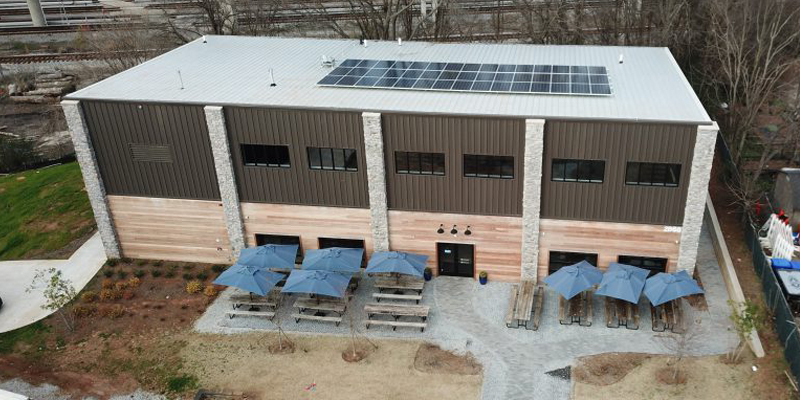
AVONDALE ESTATES, Ga. – The Lost Druid, an “own-premise” brewery in Avondale Estates is now the first brewery in DeKalb County powered with solar energy provided by Velo Solar.

The 14.1 kW solar installation was created and is maintained by Atlanta-based Velo Solar. The array will save The Lost Druid as much as 15 percent on its annual power bill. In addition to that cost savings, it will reduce the operation’s carbon footprint by 42 metric tons of CO2 each year.

Created through a special financing arrangement offered by Velo Solar, the solar equipment is provided through a Solar Energy Procurement Agreement (SEPA). This allowed the panels and other infrastructure to be installed at no upfront cost to The Lost Druid.

The Lost Druid’s solar array will produce 21,514 kilowatt hours of power annually. This helps to run the brewery’s 6,800 square-foot operation, including its brewery, taproom, aging facility, kitchen, and upstairs event space.

Stacia Familo-Hopek, owner and co-founder of The Lost Druid, said the decision to “go solar” is in keeping with the brewery’s core mission.

“The Druids respected nature, and this is one of numerous measures we employ to minimize our impact on the environment,” she said. “Other environmentally sensitive initiatives we use include reclamation of our chilling water, a natural carbonation process, LED lighting and providing spent grain to local farmers for livestock feed.”

She said The Lost Druid selected Velo Solar to provide the solar installation because of Velo’s demonstrated expertise and customer-centric approach.

Britt Lothridge, director of sales for Velo Solar, said Georgia business owners have more options than ever to add solar to their energy resources. SEPAs make it easy to save money and contribute to a healthier environment, he explained.

“This is a great option for forward-thinking clients who want to reduce their reliance on utility-provided power without a hefty upfront investment,” he said. “They not only pay less for electricity month-to-month, but they also reduce reliance on fossil fuels.”

About Velo Solar
Velo Solar, a premier full-service solar EPC (engineering, procurement, and construction) firm headquartered in Atlanta, Georgia, has been powering commercial businesses with sustainable renewable energy solutions since 2008. Specializing in turnkey commercial solar installations, energy storage systems, real-time monitoring through proprietary PowerEnfo software, and comprehensive operations and maintenance services, Velo Solar’s innovative design-build approach ensures customized, data-driven projects that reduce costs, enhance resiliency, and support sustainability goals for clients across the Southeast and beyond.

For more information, visitwww.velosolar.com.

About The Lost Druid
The Lost Druid Brewery & Distillery, nestled in the vibrant town of Avondale Estates, Georgia, was founded by Robert Hopek and his wife Stacia Familo-Hopek, drawing inspiration from ancient Druid connections to nature, beer, and the solstices—particularly meaningful as Robert was born on the Winter Solstice. What began as a vision in the early 2010s came to fruition in June 2019 with a grand opening timed precisely to the summer solstice, marking it as one of the first own-premise breweries in the area following Georgia’s updated beer laws. A longtime homebrewer with a background in technology entrepreneurship, Robert Hopek serves as the master brewer, crafting small-batch beers on a Slovenian Brewiks system while fostering a community-focused taproom that has earned accolades, including top rankings in Atlanta’s craft beer scene.

The Lost Druid’s ever-changing lineup features innovative takes on classic styles inspired by American, European, and global traditions, including standout offerings like the refreshing Reaper of Souls ale-lager hybrid, the honey basil-infused Aromatic Hive, hazy IPAs, fruit-forward tarts and sours from the Art of Tart series, smoked malts in beers like Great Trilithon, and bold imperials such as bourbon barrel-aged Dagda. Community-driven brewing often incorporates customer suggestions and culinary influences, paired with unique hard seltzers and spirits from the on-site distillery, all served in a welcoming gastropub setting with pet-friendly patios and chef-crafted shareable plates designed to complement the beers.

Visit thelostdruid.com for more information and updates, or search @thelostdruid on Instagram, Facebook and Twitter.

For today’s beer news: Click Here

Filed Under: Uncategorized

America’s Coolest Home Brewery built by Chris Bowen of Hammersmith Ales

July 21, 2020 by Andrew Innes

America’s Coolest Home Brewery built by Chris Bowen of Hammersmith Ales

America’s Coolest Home Brewery built by Chris Bowen of Hammersmith Ales
HammerSmith Ales started in 2005 , the idea for the name Hammersmith was originally inspired after the town outside of London, England. HammerSmith is rich in history and has a few landmarks significant to music, a famous bridge and an important stop along the river Thames. Chris’s interest in British culture started many years ago, he has always been a fan of British beer , authors of literature, and British personalities. Early on in my exploration of beer, he quickly discovered breweries like Fuller’s, Shepard Naeme, Young’s, Samuel Smith and Greene King. When he started brewing, he quickly decided that he was going to focus on British style beers like English Bitters, Extra Special Bitter , India Pale Ale, Old Ale and Barleywine.

Video

Savant Systems 1400
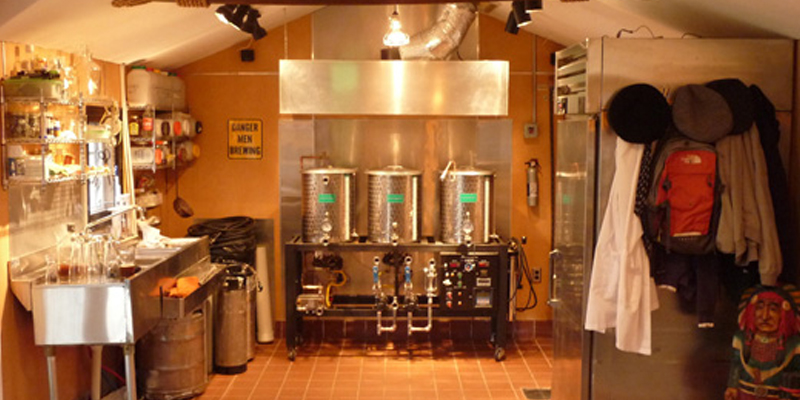
This portable brewery on wheels is a HERMS system =Heat Exchanged Recirculating Mash System. Total finished brewing size is 10 gallons. Water is induced from a Reverse Osmosis System and is built back up again depending on the style and region of original brewing water. The system can reproduce approximately 70 different water profiles thoughout the world. Replicating water from the likes of Dublin, London, Pilsen, Dortmunder and Prauge are within our grasp. This system was custom built from scratch, all the plans and designs are a patent pending design of Hammersmith Ales 2006

For Fun Beer Facts, Trivia and more: Click Here
Filed Under: Uncategorized

Most Haunted Bars in America

June 16, 2020 by Andrew Innes

Haunted Bars in America


America’s Oldest and Most Haunted Bars: Where History Meets the Supernatural

The White Horse Tavern (1673)
Established in 1673 in Newport, Rhode Island, the White Horse Tavern is widely regarded as the oldest operating bar in the United States. This colonial-era gem once served as a gathering spot for merchants, sailors, and even pirates, and its rich history has led to numerous ghost stories. The most persistent legend involves a spectral elderly gentleman believed to be a former boarder who died unexpectedly in an upstairs room during the late 17th or early 18th century. Patrons and staff report sightings of a shadowy figure in colonial attire near the fireplace or on the upper floors, along with sudden chills, unexplained footsteps, and a melancholic presence that lingers in the historic building’s dimly lit corners. Location: 26 Marlborough St, Newport, RI Website: www.whitehorsetavern.us

Lafitte’s Blacksmith Shop Bar (circa 1772)
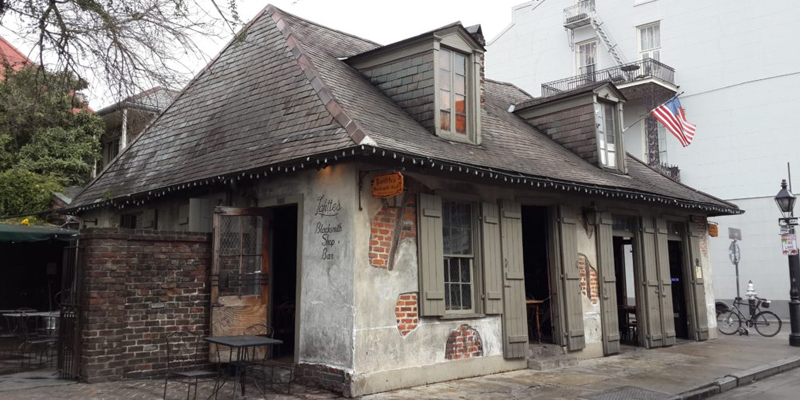
Nestled on Bourbon Street in New Orleans, Louisiana, Lafitte’s Blacksmith Shop Bar is one of the oldest structures used as a bar in America, dating back to the 1770s. Originally a front for pirate Jean Lafitte’s smuggling operations, this candlelit piano bar preserves its eerie, old-world charm. Many believe Lafitte’s spirit remains, with sightings of a tall, commanding figure in period attire near the fireplace—often vanishing when approached. Visitors report glowing red eyes in the grate, whispers, flickering candles, and a heavy presence, attributed to the pirate guarding his former domain. Additional spirits, possibly from the building’s secretive past, add to the paranormal allure. Location: 941 Bourbon St, New Orleans, LA Website: www.lafittesblacksmithshop.com

Shaker’s Cigar Bar (1894 building, speakeasy era 1920s)
Shaker’s Cigar Bar in Milwaukee, Wisconsin, embraces its reputation as one of America’s most haunted bars, with a dark history as a Prohibition-era speakeasy, brothel, and cooperage tied to Schlitz Brewing. Prominent spirits include Elizabeth, a young girl whose tragic death haunts the bathroom with faucets turning on independently and mirror apparitions, and Molly, a brothel worker brutally murdered in the penthouse—her presence marked by footsteps, cries, and shadowy figures. The building, reportedly over an old cemetery, buzzes with activity like moving objects and cold spots. Owner-led ghost tours delve into these tales, inviting visitors to experience the lingering energy. Location: 422 S 2nd St, Milwaukee, WI Website: www.shakerscigarbar.com

Captain Tony’s Saloon (1851 building, saloon since 1930s)
Built on the site of Key West’s former morgue, Captain Tony’s Saloon in Florida features a notorious “hanging tree” growing through the bar—once used for executions—and graves beneath the floor, including that of “Lady in Blue” Elvira, hanged for murder. Patrons report eerie sensations, locked bathroom doors, and sightings of her ghostly figure. The bar’s macabre decor, including human remains discovered during renovations, amplifies its haunted vibe in this pirate-filled paradise. Location: 428 Greene St, Key West, FL Website: www.capttonyssaloon.com

Pioneer Saloon (1913)
In the near-ghost town of Goodsprings, Nevada, the Pioneer Saloon is a Wild West classic with bullet holes in the walls from a 1915 cheating-at-cards shooting that killed miner Paul Coski—his spirit is said to linger near the poker tables. Additional hauntings include an old miner in crumpled attire and cries in the restroom, drawing paranormal enthusiasts to this historic spot featured in films and games. Location: 310 W Spring St, Goodsprings, NV Website: www.pioneersaloon.info

Ear Inn(early 1800’s) – The Ear Inn has been serving drinks since the early nineteenth century and is considered on of New York City’s oldest bars. Because of its location next to the Hudson River, the inn was frequented by sailors, merchants, pirates, and many of the city’s undesirables. The building was also reportedly used as a brothel during the nineteenth and early twentieth centuries, when it was also a speakeasy. 326 Spring St. New York, NY Website: www.earinn.com  

The Menger Bar(1859) – This bar is located in the Menger Hotel. This hotel is often called the “most haunted hotel in Texas.” There are said to be thirty-two different entities roaming the bar, hotel, and restaurant. Some of them, like the ghost of Teddy Roosevelt, are said to be good-natured and friendly. 204 Alamo Plaza, San Antonio, Texas Website: www.mengerhotel.com

Whitehorse Tavern(1673) – The oldest bar in the United States, of course, has some ghost stories to tell. The Whitehorse Tavern was opened in the Rhode Island Colony in 1673, making it the oldest bar in the country. Walking alone in the building feels a bit creepy, especially when one knows at any time they might see one of the spirits wandering around. One of the ghosts is an elderly gentleman who died while renting a room upstairs in the early years of the Whitehorse. 26 Marlborough St., Newport, RI. This tavern is the oldest on our most haunted bars list. Website: www.whitehorsetavern.us

Simon’s Tavern(Legally opened in 1934) – Located in Chicago’s Andersonville neighborhood this cafe, turned speakeasy, turned legitimate bar, has quite a few ghost stories to share. This bar has it all, including a love triangle complete with shunned lovers, a horrible car accident, and an expensive and extensive family cover-up. Stop by the bar, ask for Scott and request the nickel tour, then watch and listen as he tells you about the bar’s haunted happenings—guaranteed to be a chilling experience. Finish it off with a few drinks at the bar and if you’re lucky, a ghost or two may join you. 520 N. Clark Street, Chicago IL

Bridge Café(1794) – This cafe originally opened as a grocery and porterhouse, the Bridge Café is one of New York City’s oldest bars. Throughout its colorful past it has been a pirate haven, brothel, and speakeasy, and today’s paranormal activity reflects its notorious history. From random footsteps on the second floor, unexplained scents of lavender (the perfume of eighteenth- and nineteenth-century prostitutes), malfunctioning electronics, and unexplained late-night parties, the Bridge Café is sure to please those in search of paranormal activity. Hopefully will reopen soon after Hurricane Sandy put the bar underwater. 279 Water St. New York, NY. Website: www.bridgecafenyc.com

The Tavern(1916) – During Prohibition, this Austin favorite was a grocery store by day and upscale bar, casino, and brothel by night—and some of the patrons refuse to leave. Numerous staff members and visitors at The Tavern report having seen a young lady dressed in early-twentieth-century garb, accompanied by her daughter while wandering the halls or looking out windows. The ghosts are thought to be Emily, a former prostitute, and her young daughter, who were supposedly killed accidentally during a fight between patrons. 922 West 12th Street, Austin, TX Website: http://www.tavernaustin.com

Tiger’s Tap Room(1919) – The Hotel Congress and Tiger’s Tap Room have played host to some of history’s most nefarious characters: John Dillinger’s gang stayed here, and Wyatt Earp shot and killed Frank Stilwell right across the street. But to really experience the hotel’s late-night spiritual activities, spend the night in room 242, where a hotel guest took her own life; if you examine the closet you can still see the bullet hole. 311 E. Congress St., Tucson, Arizona Website: hotelcongress.com

Arnaud’s(1918) – This New Orleans bar and restaurant is located right next to the world-famous Bourbon Street, right in the middle of some of America’s most active spirit haunts. New Orleans has the most haunted bars in Lousianna.  Today, Arnaud’s is haunted by a wide variety of ghosts, including those believed to be spirits of opium fiends, apparitions of gentlemen enjoying a late night at the bar, and even Arnaud himself appearing at random to look in on his legacy. 813 Bienville Avenue, New Orleans, LA. Website: www.arnaudsrestaurant.com

For Brewing fun fact, trivia, movies and more, Click Here.


Other Notable Haunted Bars:

  • Simon’s Tavern (1934), Chicago, IL – A former speakeasy with tales of love triangles and cover-ups; ask for the “nickel tour.” Website: www.simonstavern.com
  • Bridge Café (1794), New York, NY – A pirate haven turned brothel/speakeasy; reports of footsteps and scents (note: closed since Hurricane Sandy, with potential reopening). Website: www.bridgecafenyc.com
  • The Tavern (1916), Austin, TX – Haunted by Emily and her daughter from a deadly brawl. Website: www.thetavernaustin.com
  • Tiger’s Tap Room at Hotel Congress (1919), Tucson, AZ – Tied to outlaw John Dillinger; a tragic ghost in Room 242. Website: www.hotelcongress.com
  • Arnaud’s (1918), New Orleans, LA – Spirits of past patrons and the founder himself. Website: www.arnaudsrestaurant.com
  • Ear Inn (early 1800s), New York, NY – Sailor and pirate haunt with footsteps and shadows. Website: www.earinn.com
  • The Menger Bar (1859), San Antonio, TX – In Texas’ most haunted hotel, with 32 spirits including Teddy Roosevelt. Website: www.mengerhotel.com


For Fun Beer Facts, Trivia and more: Click Here

Filed Under: Beer, craftbeer

Primary Sidebar

Follow us

  • Email
  • Facebook
  • Instagram
  • Twitter
  • YouTube

2025 U.S. Open Beer Championship  
Medal Winners

 
2024 U.S. Open Cider Championship  
Medal Winners

Archives

  • January 2026
  • December 2025
  • November 2025
  • October 2025
  • September 2025
  • August 2025
  • July 2025
  • June 2025
  • May 2025
  • April 2025
  • March 2025
  • February 2025
  • January 2025
  • December 2024
  • November 2024
  • October 2024
  • September 2024
  • August 2024
  • July 2024
  • May 2024
  • April 2024
  • March 2024
  • November 2023
  • October 2023
  • August 2023
  • July 2023
  • June 2023
  • May 2023
  • April 2023
  • October 2022
  • May 2022
  • February 2022
  • January 2022
  • June 2021
  • March 2021
  • December 2020
  • September 2020
  • August 2020
  • July 2020
  • June 2020
  • February 2020
  • November 2019
  • February 2019
  • May 2018
  • April 2018

Copyright © 2026 · BeerInfo.com. All Rights Reserved.