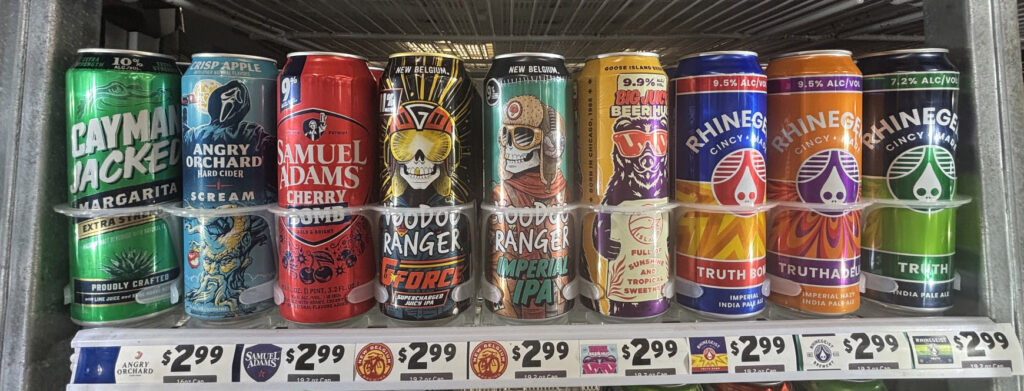
 Walk into any beer store in America today and the cooler door looks like an art gallery: row after row of tall, brightly wrapped 16-ounce cans, most of them bundled in fours. It wasn’t always this way. When I opened Friends Brewing in Helen, Georgia, back in 1989, a craft brewer putting beer in a can would have been laughed out of the room. Cans were for cheap lawnmower lager; serious beer came in brown glass. Fast forward a generation and the tallboy, once the blue-collar workhorse of the corner store, has become the signature package of American craft beer. Here’s how the pounder climbed to the top shelf.
 Milwaukee Roots
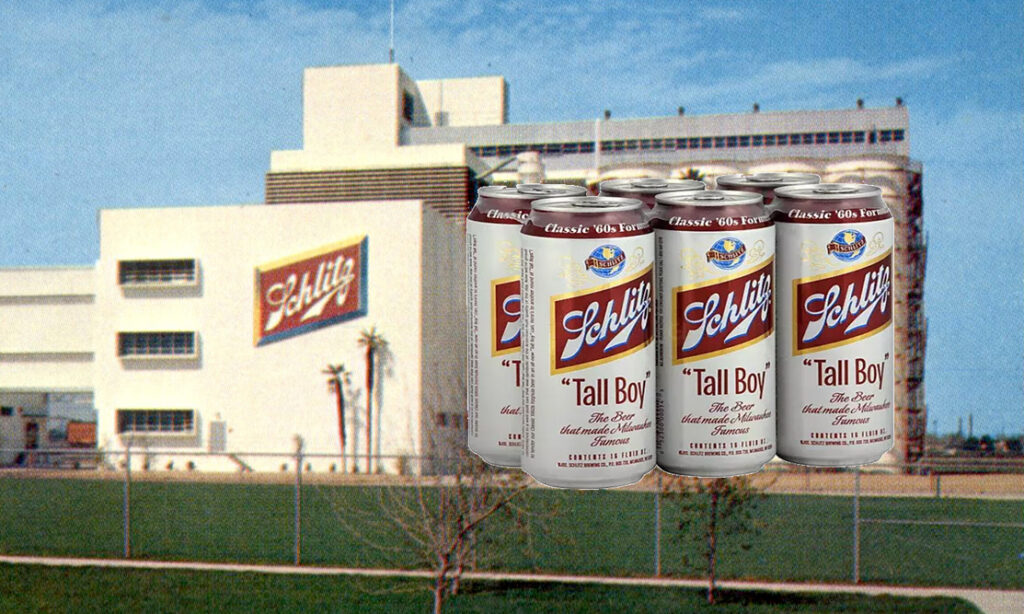
The tallboy is older than most of the people drinking from it. Milwaukee’s Joseph Schlitz Brewing Company was one of the first big brewers to supersize the can, introducing a half-quart (16-ounce) can in 1956. Four years later Schlitz rolled out a 24-ounce can it actually called the “Tall Boy,” and the name stuck to every can bigger than the standard 12-ouncer. Dictionaries trace that beer-can meaning of “tallboy” to the 1950s, and Merriam-Webster eventually gave it a formal entry.
For the next half century the 16-ounce can lived mostly in gas-station coolers, ballparks and bowling alleys. Pabst, Schlitz, Old Milwaukee, Hamm’s and Narragansett all had their pounders. When Pabst brought back the Schlitz Tall Boy in 2010, it came in the 16-ounce size, a nod to how the format had become the standard meaning of the word.
Craft Beer Learns to Can
The turning point came in a Colorado mountain town. In November 2002, Dale Katechis of Oskar Blues Brewery in Lyons began hand-canning Dale’s Pale Ale, widely credited as the first craft beer to be canned by the brewery that made it. (Fun Southern footnote: Katechis first brewed the recipe in his bathtub as a student at Auburn University.) Employees filled the cans by hand, about sixteen cases an hour, until the brewery bought a small automated canner from Cask Brewing Systems.
Those early craft cans were 12-ouncers, but they broke the stigma. By 2011, around 50 American craft breweries were canning. Brewers discovered what big brewers had known for years: cans keep out light and oxygen, chill faster, weigh less, and pack tighter. Jack’s Abby in Massachusetts has noted that a truckload of canned beer carries about four times the liquid of a truck loaded with bottles.
Heady Topper and the Four-Pack Revolution
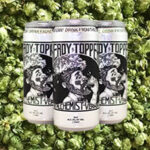
If Oskar Blues made cans respectable, a little brewery in Vermont made the tallboy cool. Around 2013, beer fans began lining up outside The Alchemist in Waterbury to buy Heady Topper, a hazy double IPA sold in 16-ounce cans, four to a pack, with “Drink from the can!” printed right on the label. Brewers Association chief economist Bart Watson has pointed to Heady Topper as one of the first beers sold in 16-ounce four-packs and a key reason the format spread.
The New England IPA boom did the rest. Hazy, juicy IPAs and the 16-ounce four-pack became so closely linked that by 2019 Boston-area beer writers were warning that a good beer could sit on the shelf if it came in a six-pack instead of a four-pack. That same year, 16-ounce cans were the fastest-growing package size in craft, up about 21 percent. In taprooms, the four-pack of tallboys became the default to-go purchase.
Why Brewers Love the Tallboy
A bigger canvas. A 16-ounce can gives designers more room for bold, eye-catching artwork, which matters when hundreds of brands are fighting for the same cooler door. Pint-sized pricing. A tallboy holds exactly a U.S. pint, so brewers can price and market it like a draft pour at the bar. Four of them can sell for about what a six-pack of 12-ounce cans would.
Mobile canning. Small breweries that could never afford a bottling line can hire a mobile canning truck for a day, label cans with shrink sleeves or stickers, and release a new beer in limited batches.
Easier on the wallet and the planet. Aluminum is light, stackable and endlessly recyclable, cutting shipping costs for brewers working on thin margins.
Why Drinkers Love It
For drinkers, the tallboy hits a sweet spot: more than a standard can, less of a commitment than a bomber. A four-pack also makes it easier to try something new without being stuck with six of a beer you didn’t love. And there’s a certain swagger to it. Canadian brewers interviewed by CBC described the tall can as projecting both trendiness and blue-collar appeal at the same time, which may be the perfect summary of modern craft beer.
The tallboy has also spread well beyond beer. Ciders, hard seltzers and canned cocktails now routinely come in 16-ounce cans. In January 2025, federal regulators approved new standards of fill that allow ciders and wines at 7% ABV and above to be sold in 16-ounce and 19.2-ounce cans, something previously limited to lower-alcohol ciders.
The Stovepipe: Enter the 19.2-Ounce Can
If the 16-ounce can is craft beer’s pint, the 19.2-ounce “stovepipe” is its imperial pint. That’s literal: 19.2 U.S. ounces is about 568 milliliters, the size of a British pint. For years the extra-tall can mostly showed up at stadiums, concerts and festivals, where people buy one beer at a time. Then it moved into the gas station.
The change came fast. Around 2017, 22-ounce bomber bottles held more than 75 percent of craft single sales in convenience stores. By 2023 the 19.2-ounce can held more than 92 percent, according to Circana data shared by Molson Coors. Craft stovepipe sales jumped about 39 percent from 2021 to 2022, to $295 million. They rose nearly 42 percent more in 2023, to more than $400 million, then another 23 percent in 2024, the biggest percentage gain of any craft package. The once-mighty bomber now accounts for about 1 percent of craft single-serve volume.
Why the stovepipe works:
• Built for the quick stop. Convenience-store industry data shows most items bought there are consumed within an hour, so shoppers want one cold beer, not a six-pack.
• Big beer, big value. Stovepipes are often hoppy, high-ABV IPAs, and a single can holding more than a pint feels like a deal at the register.
• Stadium habits. Drinkers used to buying big single cans at ballparks and concerts are comfortable grabbing one on the way home.
• Even more canvas. The taller can gives brewers extra room for artwork that pops in a crowded cooler.
Georgia readers will like this one: Athens-based Terrapin’s Depth Perception Imperial IPA saw its convenience-store sales jump nearly 383 percent in 2022 in the stovepipe format. Dale’s Pale Ale, Dogfish Head 60 Minute IPA and Tröegs Perpetual IPA are now common sights in 19.2s.
The stovepipe isn’t a sure bet for every brewery. Smaller producers have found it hard to hit a competitive price on a single can and to win cooler space in convenience stores. Still, in 2025 the 19.2-ounce can made up 60 percent of single-serve craft volume, up from 55 percent a year earlier, and its volume grew 7 percent while most other craft packages shrank. In a tough market for craft beer, it’s one of the few packages still growing.
Where the Tallboy Stands Today
Cans have won the packaging war. In 2025, aluminum cans accounted for 78 percent of packaged craft beer volume, with glass down to 22 percent, according to the Brewers Association. In Vermont, Heady Topper’s home state, cans hold 89 percent of off-premise craft sales.
But the tallboy’s growth spurt is maturing. Four-packs made up about 11 percent of craft volume in 2025, down a point from 2022, while six-packs (45 percent) and 12-packs (31 percent) still carry most of the load as value-minded drinkers look for more beer for the money. Among single cans, the even taller 19.2-ounce “stovepipe” has taken over, while 16-ounce singles slipped to 11 percent of single-serve craft volume. Rising aluminum costs, including a 25 percent tariff on imported empty cans added in 2025, have some brewers rethinking package sizes again.
Still, the 16-ounce four-pack remains the calling card of the independent taproom, the hazy IPA and the limited release. My son Cam and I have been visiting breweries together for more than a decade, and over that stretch the to-go cooler at the end of the bar has gone from bottles and growlers to nearly wall-to-wall tallboys. Schlitz may have invented the pounder, but craft brewers gave it a second life, and it doesn’t look like it’s going anywhere soon.
For Brewing fun fact, trivia, movies and more, Click Here.