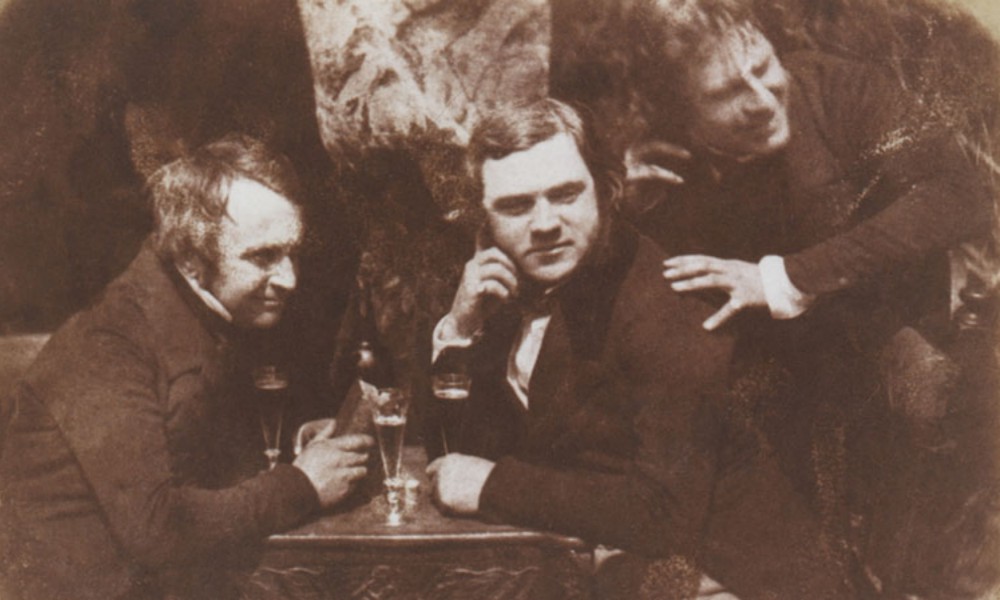
Picture this: it’s 1844 in Scotland, and the first photo of folks drinking beer is snapped, just 18 years after the world’s first photograph. Scottish shutterbugs Robert Adamson and David Octavius Hill are behind the lens, capturing a chill moment.
Hill wasn’t just a tech whiz with his calotype camera—he had a knack for charm, cracking jokes, and reading the room, which made his photos pop. In this shot, he’s on the right, likely sharing a laugh and a brew with his pals James Ballantine and Dr. George Bell. Bell, the guy in the middle, helped shake up Scotland’s poor relief system with the 1845 Poor Law and wrote Day and Night in the Wynds of Edinburgh. Ballantine? He was a writer and stained-glass artist, plus his dad was an Edinburgh brewer—talk about beer in the blood!
On the table, you’ve got a classic beer bottle and three fancy 19th-century “ale flutes” for sipping. Word on the street was that Edinburgh’s favorite brew, Younger’s ale, was so strong it practically stuck your lips together. No wonder most folks could barely finish a single bottle!
Photography before 1850
Before 1850, photography was still a fragile, experimental miracle that only a handful of wealthy amateurs and scientists could actually practice. The earliest permanent images—Nicéphore Niépce’s 1826 heliograph of a rooftop in France—required an eight-hour exposure on a pewter plate coated with bitumen, while Louis Daguerre’s polished silver-plated daguerreotypes (publicly announced in 1839) cut exposure times to minutes but produced one-of-a-kind positives that couldn’t be duplicated and were insanely delicate. Across the Channel, William Henry Fox Talbot’s calotype process (also introduced in 1839) used paper negatives to allow multiple prints, yet the images were softer and the process was maddeningly slow and chemically unstable. Every photograph before 1850 was essentially handmade: exposures ranged from several minutes to half an hour, sitters had to stay motionless with head clamps, cameras were the size of small suitcases, and toxic chemicals like mercury vapor or silver iodide fumes made darkroom work genuinely dangerous. Fewer than a few thousand photographs existed worldwide, most were unique objects rather than reproducible images, and the idea of photography as something ordinary people could own—or that it could document daily life—was still pure science fiction. In short, pre-1850 photography was less an art form or industry and more an expensive, hazardous alchemy practiced by a tiny elite on the very edge of possibility.
For Fun Beer Facts, Trivia and more: Click Here