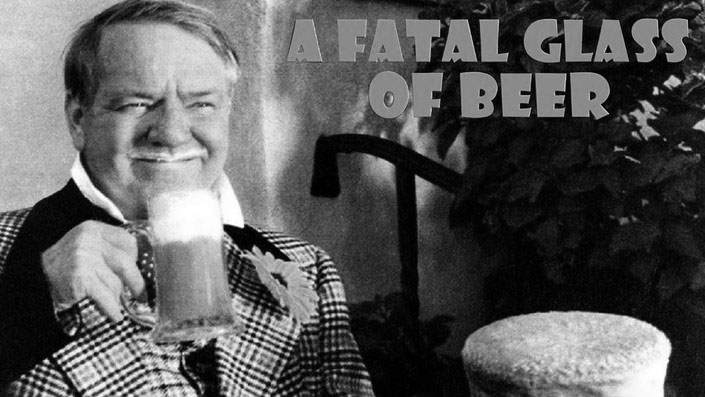
The oldest beer movie known to man is “The Fatal Glass of Beer (1933)”. This film is a short comedy movie starring W.C. Fields, known for its absurdist humor and deadpan delivery. Set in the Yukon during the Klondike Gold Rush, the film follows the story of Mr. Snavely (Fields), a dour, long-suffering man living in a remote snow-covered cabin with his wife. Their son, Chester, left home to seek fortune in the city but was led astray by the temptations of alcohol—symbolized by the “fatal glass of beer.”
The film satirizes morality plays and melodramas of the time, with exaggeratedly tragic storytelling and intentionally clumsy staging. Fields frequently breaks the fourth wall, delivering the film’s most famous recurring gag: after dramatically declaring, “And it ain’t a fit night out for man nor beast!” he immediately gets a handful of fake snow tossed into his face.
With its surreal, anti-comedy sensibilities and relentless parody of melodramatic tropes, The Fatal Glass of Beer remains one of Fields’ most bizarre and memorable short films.
Story about W.C. Fields
W.C. Fields was the glorious grouch who turned misanthropy into an art form, a red-nosed virtuoso who hated children, dogs, and just about everything else that moved—except maybe a well-mixed martini and a stack of unpaid bills he could juggle like circus knives. With his bulbous schnozz glowing like a stoplight nobody obeyed and a voice that sounded like a busted bagpipe gargling gravel, he waddled through the 1930s and ’40s snarling lines that still make decent people snort their drinks: “I am free of all prejudice. I hate everyone equally.” Fields didn’t just play drunkards and con men; he elevated them into philosophers of glorious self-interest, forever scheming to swindle bankers, outwit temperance ladies, and keep one step ahead of any kid who might ask him for a nickel.
Off-screen, the myth and the man happily arm-wrestled each other. He kept dozens of bank accounts under fake names (his favorite pseudonym: “Mahatma Kane Jeeves”), hoarded cash in trunks because he trusted banks about as much as he trusted a teetotaler’s handshake, and once told a process server, “Tell ’em I’m out of town—permanently.” He claimed to have started juggling at age nine to fend off his abusive father, which explains why every apple he ever tossed in a movie looked personally offended. Fields died on Christmas Day 1946—a holiday he openly despised—just to get the last laugh, presumably while muttering, “On the whole, I’d rather be in Philadelphia,” the line carved on his tombstone as the ultimate raspberry to the universe. Somewhere right now he’s probably trying to return a cloud to Saint Peter, claiming it has a hole in it.
W.C. Fields Quotes:
- “I am free of all prejudice. I hate everyone equally.”
- “Never give a sucker an even break.”
- “It ain’t what they call you, it’s what you answer to.”
- “I cook with wine; sometimes I even add it to the food.”
- “Horse sense is the thing a horse has which keeps it from betting on people.”
- “I never vote for anybody; I always vote against.”
- “Anyone who hates children and dogs can’t be all bad.” (Actually said about Fields by someone else at a dinner, but he loved it so much he repeated it forever.)
- “A woman drove me to drink and I never even had the courtesy to thank her.”
- “If at first you don’t succeed, try, try again. Then quit. No use being a damn fool about it.”
- “I like children—fried.” (Apocryphal, but so perfectly in character that it stuck.)
- “Some weasel took the cork out of my lunch!”
- “Ah, the patter of little feet around the house—there’s nothing like having a midget for a butler.”
- “I’d rather have two barrels of Yesterday’s Sauerkraut than all the flowers in the world.”
- “On the whole, I’d rather be in Philadelphia.” (His self-penned epitaph)
- “Christmas at my house is always at least six or seven times more pleasant than anywhere else. We start drinking early. And while everyone else is seeing only one Santa Claus, we’ll be seeing six or seven.”
Fun Beer Facts, Breweries and More: Click Here